

Why AI is becoming essential infrastructure for the security guarding sector
Security guarding has always been a people business, and that isn’t changing. What is changing is everything around the people — the compliance burden, the scheduling complexity, the proof clients now demand, and the margins that make doing all of this manually harder every year. AI isn’t replacing the guard on site. It’s replacing the spreadsheet, the manual check, and the after-the-fact scramble behind them — and the firms that get this right are starting to pull ahead of the ones that don’t.
An industry running on thinner margins and thicker paperwork
Two pressures are converging on security guarding at the same time. Margins have been squeezed for years by wage floor increases, client procurement teams trained to negotiate hard, and a labour market where recruiting and retaining licensed officers is a genuine constraint, not a footnote. At the same time, the compliance and evidence burden has only grown — SIA licensing, BS7858 vetting, ACS audit requirements, and increasingly demanding client SLAs that expect provable, not just claimed, performance.
Running both of those pressures through manual processes — spreadsheets, paper vetting files, scheduling by memory and phone calls — was always going to hit a ceiling. A growing number of firms are finding that ceiling now.
Where manual processes actually break down
The failure points are rarely dramatic. They’re quiet and cumulative: a licence that expires without anyone noticing until a client audit surfaces it, a shift covered at the last minute by whoever’s available regardless of whether their vetting file is current, a patrol that happened but was never properly logged, an ACS audit that turns into a week of gathering evidence that should have already existed. None of these are guarding failures. They’re the predictable result of asking manual, memory-dependent systems to manage a workforce and a compliance regime that have both grown past the point where that’s realistic.
This is the specific gap AI-enabled workforce management is built to close — not by replacing judgement, but by handling the continuous, detail-heavy tracking that human attention reliably drops under pressure.
Where AI is already changing the sector
A handful of applications are moving from novelty to standard practice faster than most of the industry expected:
Compliance that tracks itself. Rather than periodic manual reviews, AI-driven systems continuously monitor SIA licence status and BS7858 vetting expiry, flag renewals early, and — critically — prevent non-compliant scheduling before it happens, rather than catching it afterwards.
Scheduling that anticipates gaps. Predictive scheduling tools flag rota gaps before they occur, based on absence patterns, contract requirements, and licence status, instead of managers discovering a gap the morning it happens.
Proof of presence as a by-product of the work. Patrol and attendance data captured automatically — checkpoints, timing, completion — turns “we were there” into something a client can actually verify, without anyone reconstructing it after the fact.
Natural-language reporting and querying. Instead of a manager manually compiling a client SLA report, an AI agent can generate it directly from operational data — a meaningful time saving at scale, and a more consistent one than manual compilation tends to produce.
Audit-ready evidence, permanently. ACS audits and client compliance reviews increasingly get answered from data that’s already current, rather than assembled under time pressure — because the system has been maintaining it continuously rather than periodically.
None of this is speculative. It’s the practical, unglamorous end of AI adoption — closer to automated compliance and operations than to anything resembling a chatbot gimmick, which is exactly why it’s proving durable rather than a passing trend.
A case in point: MiSentinel
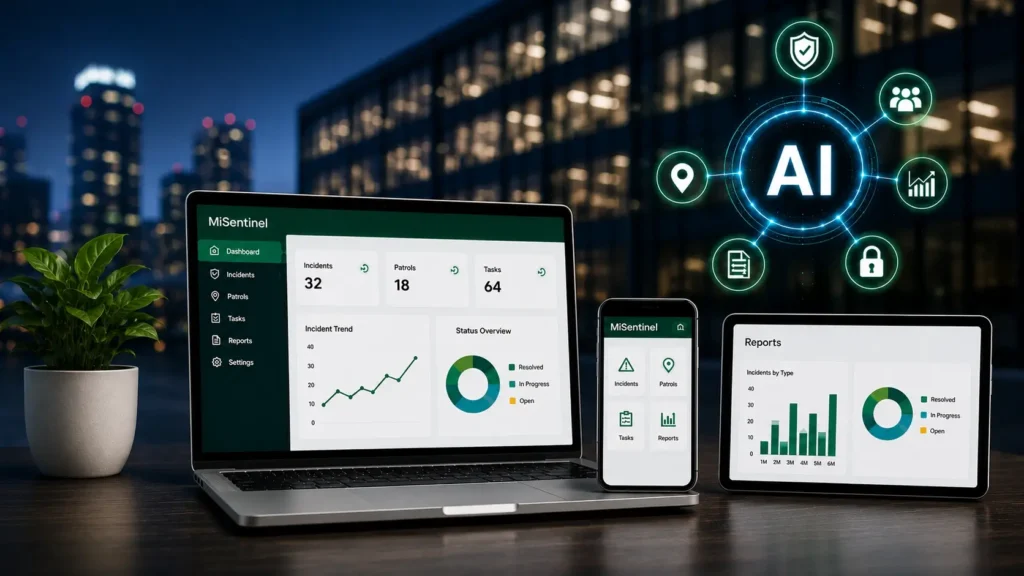
MiSentinel is a useful illustration of where this is heading, precisely because it isn’t marketed as an AI novelty — it’s workforce management software for security guarding and facilities management, built around the operational problems described above. SIA licence tracking and automated expiry alerts. BS7858 vetting workflows. Patrol and proof-of-presence reporting captured as shifts happen. ACS audit evidence maintained continuously rather than assembled reactively. TUPE-ready staff records for contract transitions, one of the highest-risk moments for compliance gaps to appear unnoticed.
The direction of travel from here is toward agentic capability layered on top of that same operational core — natural-language interfaces that let an operations manager ask about coverage, compliance status, or audit readiness directly, and predictive tools that flag risk before it becomes an incident rather than after. The pattern is consistent across the sector: AI’s near-term value isn’t in doing something guarding has never done before, it’s in making the compliance and administrative backbone of the work continuously current instead of periodically checked.
What to actually look for, if you’re evaluating this
For firms weighing up whether and how to adopt AI-driven workforce management, a few questions cut through the marketing more usefully than a feature list:
- Does the system prevent non-compliant scheduling, or does it just flag it after the fact?
- Is proof-of-presence generated automatically, or does it still require manual logging and later reconstruction?
- How early do licence and vetting renewal alerts fire — weeks, or days?
- Does audit preparation still take meaningful staff time, or is the evidence already current?
- Does the system make TUPE transitions safer, or does compliance data still risk falling through the cracks during handover?
Providers that can answer these plainly, with specifics rather than generalities, are further along than most of the market.
The direction
Security guarding will remain a people business — client trust is still built by the officer on site, not by the software behind them. But the software behind them is quietly becoming the difference between firms that can prove their performance and retain contracts, and firms that lose them for reasons that look, on the surface, like something else entirely. AI in this sector isn’t a novelty to bolt on. It’s becoming the operational infrastructure that determines whether good guarding work is actually recognised, retained, and rewarded — or quietly undermined by paperwork that couldn’t keep up.
Share on Social Media:
(UK) 0208 514 0006
To find out more about our solutions and services, get in touch!